
What we do
Hail damage repair management, run by five divisions
FMR Incident Management does hail damage repair management for South African insurers: five divisions working on one system, from the moment a claim arrives to the final repair cost.
- Every claim captured at one central point
- One call centre for every vehicle owner
- Repair centres on live diaries
- Final repair costs calculated by FMR
01 Overview
One platform for every hail claim, wherever it lands
FMR was built from experience in the hail repair market, not only from an IT point of view. It oversees every hail damage claim on a single platform, whatever town the claim is in and whichever company repairs the car.
Each participant in a project sees only what their duties need. Repair centres, call centre agents and managers each work with their own part of a claim, without the flood of information that usually comes with claims systems.
- Built for vehicles damaged by hail, and adaptable to other kinds of catastrophe later
- One record per claim, from referral to after-care
- Access set by role, so nobody wades through what is not theirs
02 The divisions
How hail damage repair management is organised at FMR
Five divisions share the work of a hail event. Each one owns a stage of the claim, and all five record it on the same system.
Back-office claim capture
Every claim at one central point
All hail damage claims are sent to one central point at FMR and captured on the system. Each claim is captured against:
- The insurance company
- The hail event: where and when the storm hit
- The system users on the claim: top level, mid level and claims handlers
- The paintless dent repair company responsible for the repair
Front-office customer care
One call centre for the owner
FMR's call centre manages every interaction with the vehicle owner, from the moment the claim is received until it is finalised:
- Appointments for assessments
- Appointments for repairs
- After-care once the car is back with its owner
Repair centre management
A log-in and a diary for every centre
Each repair centre has its own log-in and manages its bookings in a diary. Head office monitors the workload of every centre and balances it. From the workshop desktop a centre handles:
- Receiving a vehicle for repair
- Updating repair progress as the work happens
- Ordering parts online
- Delivering the vehicle back
The workshop module updates live, so progress on a claim is current, not reported after the fact.
Overall project management
Every catastrophe centre in view
Managers monitor and manage each catastrophe centre on its own, with:
- A complete overview of every project's volumes and schedules
- The means to deal with outstanding or current issues at short notice
- Control of the workload and the flow of vehicles over a given period
Operational requirements
Assessments, quotes and final costs
A separate division manages assessments, Audatex quotes and final repair costs:
- Original assessments, with their photos, are kept on FMR's server
- Audatex quotes are run by FMR's own in-house Audatex staff
- FMR calculates the final repair cost, and every contractual obligation is FMR's responsibility
03 During a hail event
What changes when FMR runs the repairs
A big storm tests every part of a claims operation at once. These are the four places FMR makes the difference.
A larger repair workforce
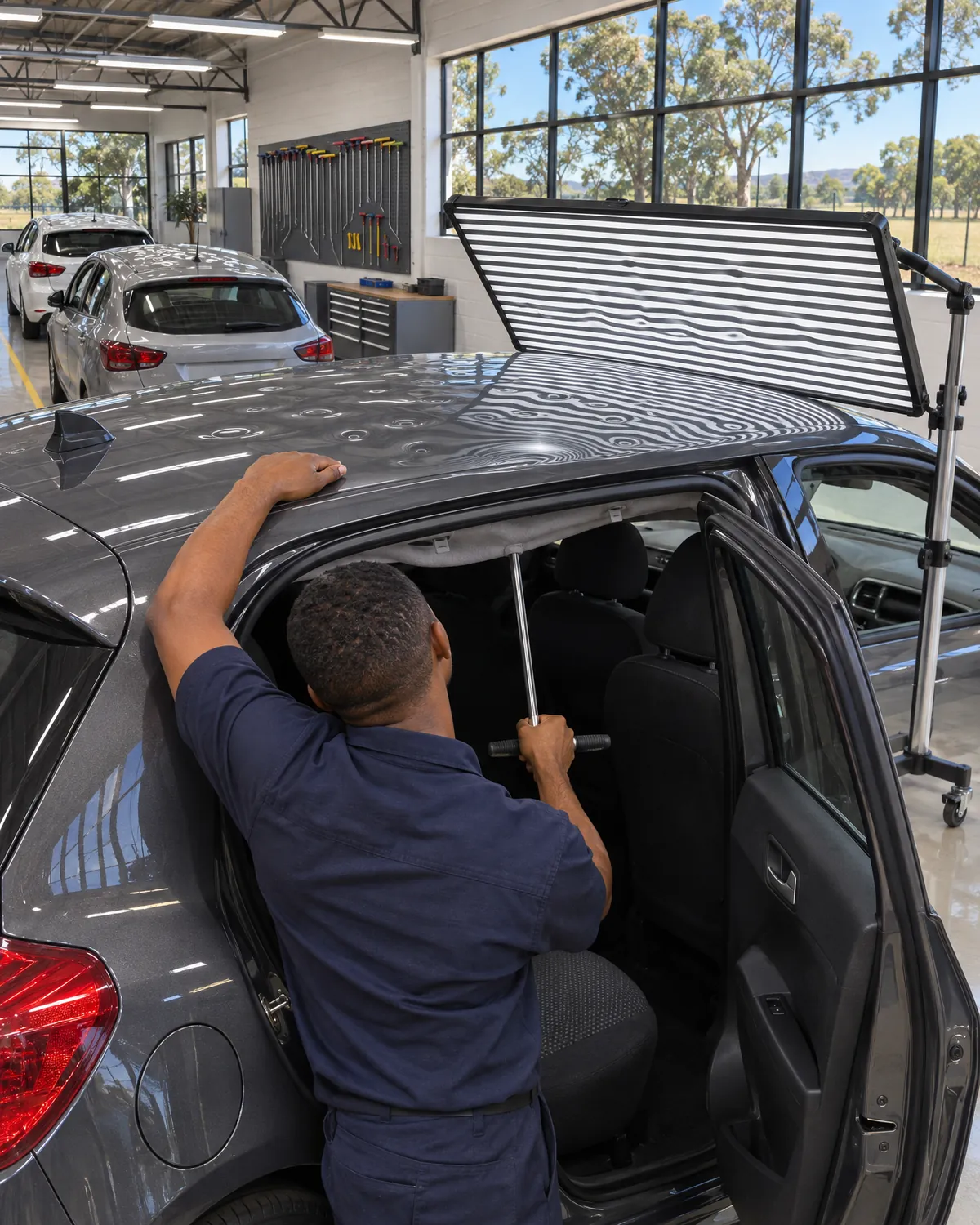
One or two contracted repair companies cannot reach claims scattered across several towns, so claims get declined and sent to panel beaters at a far higher cost. Many more paintless dent repair companies contract to FMR, so the workforce grows with the event.
No bottlenecks
Every owner wants their car first, and not everyone can be helped at once. FMR spreads the bookings so no centre is overbooked, because an overbooked centre, PDR company or panel beater, slows down and its workmanship slips.
Fewer calls
Owners follow their repair online at Follow My Repairs with a claim number or registration, so fewer of them phone in, and call centre staff make fewer follow-up calls. Agents keep their time for claims outside the catastrophe.
Statistics on every project
Insurers see statistics on several projects at the same time, from claim volumes and appointments to estimated and actual costs. See the reports insurers get.
04 Questions
How the work is done, answered
The questions claims managers ask about FMR's divisions. Vehicle owners will find theirs on the repair tracking page.
What are FMR's five divisions?
Back-office claim capture, front-office customer care, repair centre management, overall project management, and operational requirements, which covers assessments, Audatex quotes and final repair costs.
Who runs the Audatex quotes?
FMR's own in-house Audatex staff. The original assessments, including their photos, are kept on FMR's server.
Who carries the contractual obligations for a repair?
FMR does. It calculates the final repair cost, and all contractual obligations are FMR's responsibility.
How does FMR avoid repair bottlenecks after a big storm?
By spreading the bookings. Head office sees the workload in every repair centre's diary and balances it, so no centre is overbooked and repairs keep moving at a steady pace.
Can repair centres update a claim themselves?
Yes. Each centre has its own log-in to receive vehicles, update progress, order parts online and record delivery, and every update shows live.
Is the system only for hail damage?
It was designed for vehicles damaged by hail, and it can be adapted to manage other kinds of catastrophe at a later stage.
05 Talk to FMR
Put the next hail event in FMR's hands
Planning for the hail season, or already counting claims after a storm? Tell FMR where it hit and roughly how many cars are affected.
Hail claims, handled from the first call to the final cost.
Discuss a hail event FMR Incident Management
Hail damage claims management for South African insurers: every claim captured, every owner contacted, every car assessed, repaired and tracked until it goes home.
Contact
- 064 819 5431
- claims@fmrhail.co.za
- 4 Kenwood Street, Midstream Estate, Centurion, 1692
© 2026 FMR Incident Management
Back to top